How You Close Determines What They Remember | WellCrafted Story
The Last Two Minutes
Summary:
This article explains why the final moments of a presentation determine whether audiences take action. It shows how emotion, not logic, drives decisions. The result is stronger closes, clearer next steps, and more consistent outcomes.
The Last Two Minutes
We have been spending time on Reddit lately.
Not scrolling. Researching. Mining threads across professional communities for the real language people use when they talk about communication, selling, and the gap between the two.
One pattern showed up in every industry.
Smart, prepared, credible professionals who earn the room and then leave without the result they came for.
At the center of every one of those stories was the same moment.
The last two minutes.
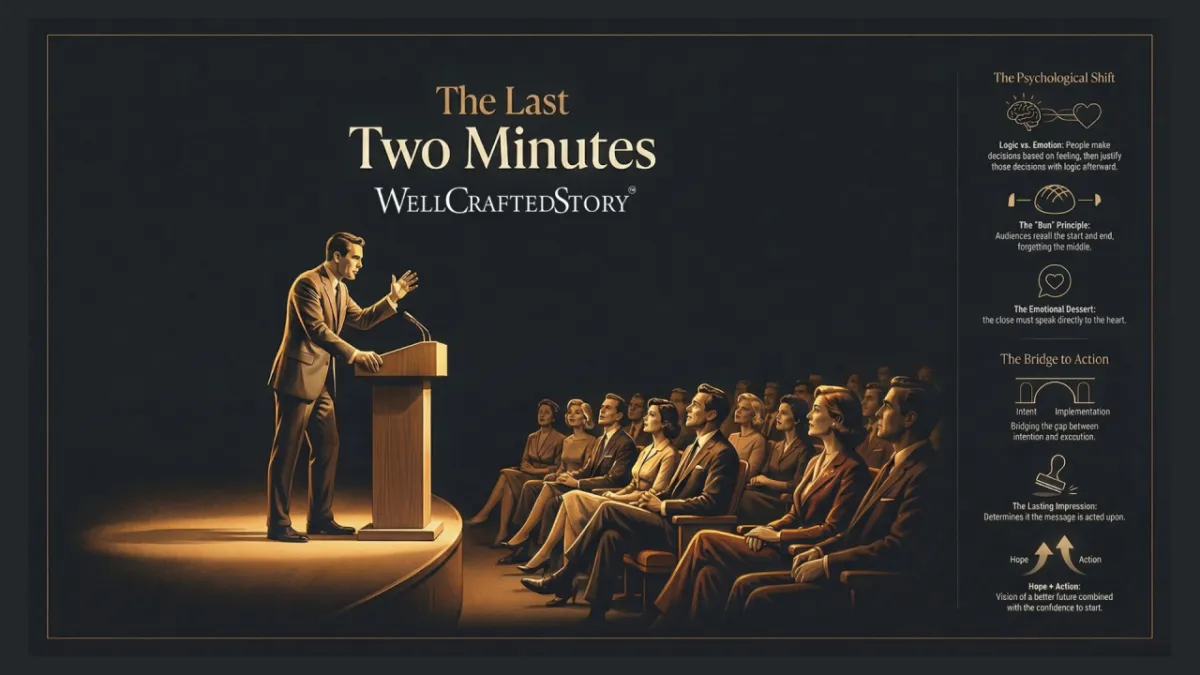
The Psychological Shift
People do not make decisions the way most presenters think they do.
They do not weigh your evidence, evaluate your credentials, and arrive at a logical conclusion.
They make a decision based on feeling. Then they use logic to justify it afterward.
This means the most important question in any presentation is not whether your content is correct.
It is whether your audience feels something at the moment you ask them to act.
Most presentations are built entirely around logic.
The data.
The proof.
The methodology.
The results.
All of it important. None of it sufficient on its own.
The feeling side of the equation lives in the last two minutes.
The Bun Principle
There is a well-documented pattern in how people remember experiences.
They remember the beginning.
They remember the end.
Everything in the middle fades.
People remember the bun more than the burger.
What this means is simple.
The forty minutes you spent preparing your content will be compressed into an impression.
And that impression is shaped almost entirely by how you opened and how you closed.
Most presenters spend ninety percent of their time on the middle.
The beginning gets attention because first impressions matter.
The end gets “let me know if you have any questions.”
That is not a close.
That is a surrender.
The Fear Nobody Names
This does not happen because professionals are unprepared.
It happens because of fear.
The fear that asking for the next step will change how the audience sees you.
That you will go from trusted expert to salesperson in a single sentence.
That fear is real.
And it shows up before a single word of the close is spoken.
The posture shifts.
The voice changes.
The energy drops.
The audience feels it immediately.
And the room that was leaning forward begins to pull back.
Not because the offer was wrong.
Because the person delivering it stopped believing in it for one critical moment.
The Emotional Dessert
Think about the last meal you truly enjoyed.
You do not remember every detail. You remember how it ended.
Your close is the dessert.
It is not a summary.
It is not a list of next steps.
It is not a disclaimer.
It is the moment that determines whether everything that came before it meant something.
A strong close speaks directly to what your audience actually wants.
Not what they said in the meeting.
What they are thinking about when the pressure is real.
When your close names that clearly, something shifts.
The audience stops evaluating and starts feeling.
And people act on feelings.
The Bridge to Action
Scott Empringham was speaking regularly.
Good rooms. Applause. Positive feedback.
And then nothing.
No calls. No clients.
The issue was not the talk.
It was the gap between what he intended to communicate and what the audience actually understood.
That gap is where most presentations fail.
The bridge is simple.
One clear, calm sentence that tells your audience exactly what happens next.
Not a pitch.
A door.
Hope Plus Action
The most effective closes share one quality.
They give the audience a vision of something better and the confidence that it is within reach.
Hope without action fades quickly.
Action without hope feels transactional.
Hope plus action creates movement.
That is what the last two minutes are for.
The room cannot say yes to a question you never asked.
If this resonates and you want to turn strong presentations into real decisions, start a conversation with us here:


