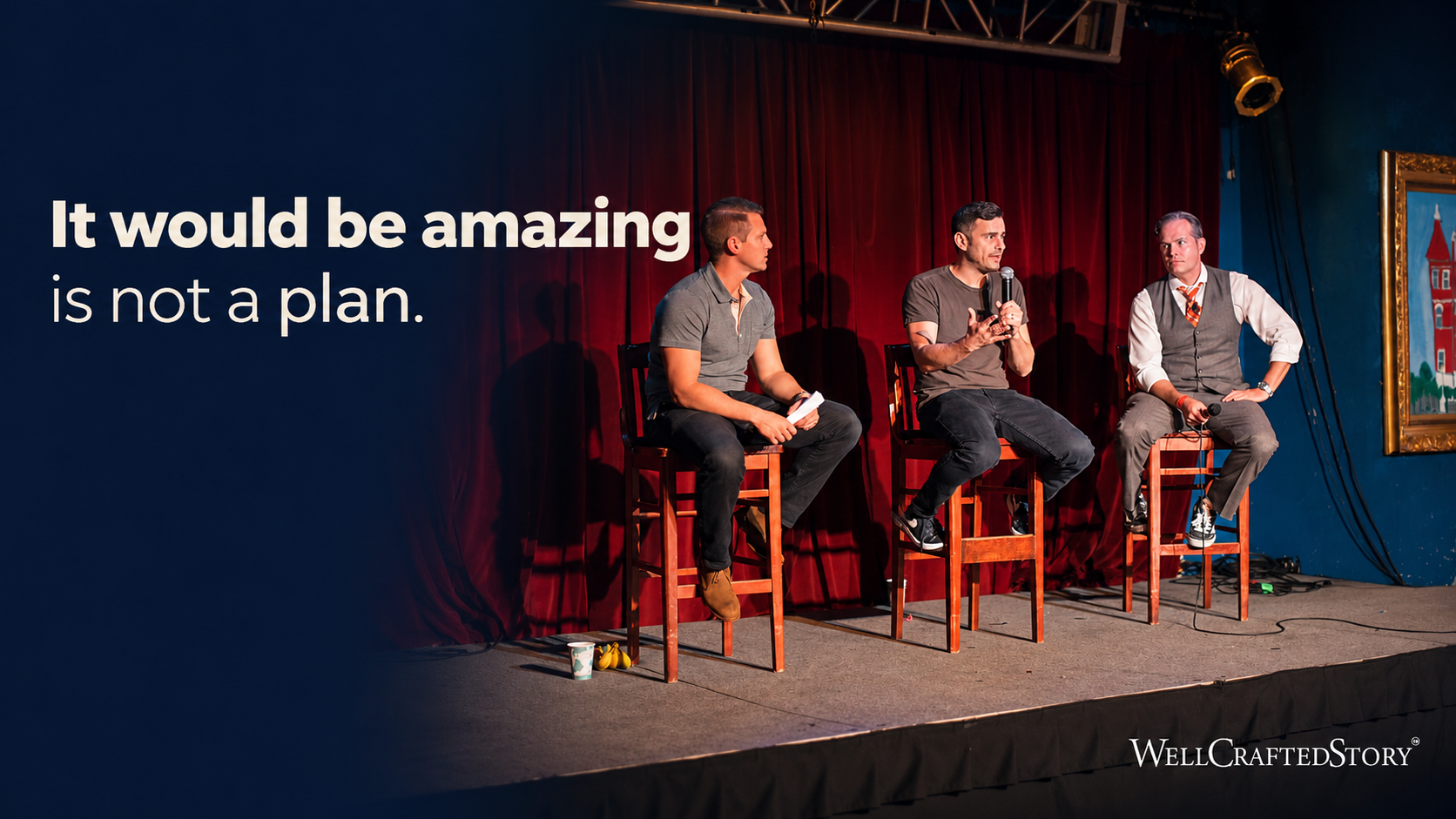
"It Would Be Amazing" Is Not a Plan
5 Minute Read
This article explains why most presentations lose half the room without the speaker ever noticing. Drawing on a story from Dave Ward and Jimmy Hays Nelson, it shows how HOW people and WOW people hear the same talk differently, and why adding data to a story makes the problem worse. The result is a presentation structure that earns both excitement and action in high-stakes presentations, investor pitches and prospect meetings.
Years ago, I found out I had been signed up for a two-day storytelling event. I hadn't chosen it, and nobody had asked me.
Jimmy Hays Nelson, now my partner at WellCrafted Story, had heard the speaker at another event, along with my business partner at the time. Both of them are WOW people. Jimmy signed up, then convinced my partner to sign me up too.
All I was told was that it would be amazing.
So I did what I always do and started researching. I wasn't looking for reasons to go. I was looking for reasons to get out of it.
Jimmy talked me into going anyway. At that event, we were encouraged to organize an event of our own. The following spring, we brought 400 men from the company we were in together in Dallas for a men's leadership event.
The year after that, more than 700 men filled the House of Blues in Dallas, and Gary Vaynerchuk was our keynote speaker. I still have a photo of the three of us on stage together.
A decision made for me turned into one of the best things I have ever done. And I almost talked myself out of it, because "it would be amazing" is not a plan.
Two Ways to Hear the Same Talk
Jimmy recently laid out the idea that explains what happened to me. Every audience has two kinds of people in it.
WOW people want the vision: what's possible, why it matters, where it could go. HOW people want the proof: how it will work, what the plan is, where the numbers are.
Jimmy is a WOW person, and I am a HOW person. As Jimmy puts it, the same presentation can inspire one person and leave the person sitting next to them unconvinced.
We didn't make this up. Psychologists Rosemary Pacini and Seymour Epstein measured these two thinking styles, one analytical and one intuitive, and found that they are independent of each other. A person can be strong in both, which means a HOW person can learn to WOW, and a WOW person can learn to build a plan.
In a room, though, most people lean one way. And most presenters build their talk for the kind of person they are.
What It Costs to Skip the HOW
Here is what my story looks like from the stage. A WOW speaker paints the picture, and the WOW people lean in and sign up. The HOW people go home and start researching their way out.
They rarely argue. They nod, they smile, and they quietly decide not to act. The speaker never knows they were lost. (He wrote more about that polite nod in Why Investors Nod and Still Don't Call Back.)
I had Jimmy, who knew me well enough to push. Your audience doesn't have a Jimmy. When you leave a HOW person without a reason to trust the vision, nobody drags them to the next step, so they just don't take it.
That is the real cost. HOW people say no to good things all the time, not because the idea was wrong, but because nobody showed them how it would work.
Why You Can't Just Add Data
The obvious fix is to bolt numbers onto the vision. It doesn't work.
Researchers from Wharton, Carnegie Mellon and Decision Research asked people to donate to Save the Children. One group read about Rokia, a seven-year-old girl in Mali. Another group read her story with statistics about the wider hunger crisis added.
The story alone drew an average of $2.38 per person. With the statistics added, giving fell to $1.43.
The data didn't add credibility. It interrupted the feeling. Stuffing proof into the middle of a story serves neither group.
The answer is structure, because each kind of listener needs its own moment. That's what the 5 C's are built to do.
Clarity comes first, so you know exactly who is in the room. Connection and the Close carry the story and the feeling, which is where WOW people decide. Content and the Call to Action carry the proof and the next step, which is where HOW people decide.
One Picture, Two Kinds of Proof
We worked with Key Real Estate Consulting, a Dallas firm that invests in mineral rights with a focus on 1031 exchanges. Mineral rights are not easy to explain, and their presentation became clear once we framed it as an analogy.
Owning mineral rights makes an energy company your tenant, with no maintenance calls, no vacancies and no late rent.
That one line works for both halves of the room. WOW people see the picture right away. HOW people get something concrete they can test, and they go looking for the proof behind it.
The Takeaway
Your audience contains a version of me. They heard the vision, they liked it, and right now they are researching their way out.
If your talks get excitement but no next steps, putting structure under your vision is the first step. Our Storytelling Blueprint walks through the 5 C's one at a time. It is free at wellcraftedstoryworkshop.com/blueprint.
I almost didn't go.
I had done my research and lined up my reasons. If it had been left at "it would be amazing," I would have stayed home. Instead, I ended up on a stage in Dallas in front of more than 700 men, standing next to my partner and Gary Vaynerchuk.
Somewhere in your next audience is someone with their reasons lined up, just like I had. Give them the vision, then give them the plan. You never know who will end up on that stage with you.
Dave Ward, Jimmy Hays Nelson, and Dr. Danny Brassell
Dave Ward, Jimmy Hays Nelson, and Dr. Danny Brassell are the founders of WellCrafted Story, a communication advisory firm that helps leaders communicate with clarity and precision in high-stakes situations.


