The Hidden Cost of Messages That Don't Move People to Action
The Hidden Cost of Messages That Don’t Move People to Action
This article explains why many well-intended messages fail to produce action and how that failure quietly costs leaders time, trust, and revenue. It shows how audiences process information, why solution-heavy communication triggers disengagement, and how aligning structure with neuroscience helps messages move people from understanding to decision.
Why do clear messages still fail to produce action?
At an investor conference filled with RIAs and family offices, a real estate operator took the stage to pitch a multifamily investment.
The numbers were strong.
The data was thorough.
The renovation plan was detailed.
Yet within minutes, attention drifted.
Not because the opportunity was weak, but because the message skipped the step the audience’s brain needed most.
The presenter led with the solution.
The audience never felt the problem.
What problem was the speaker actually solving?
This type of investment solves two distinct problems, and both must be named clearly.
The real-world problem
Outdated multifamily housing often fails to meet modern renter expectations. Aging units, inefficient layouts, and deferred maintenance reduce quality of life and suppress long-term demand. Renovation is not cosmetic. It is a response to market pressure for safer, more livable housing.
The investor problem
Investors are not buying units. They are buying stability, risk management, and predictable returns. They want confidence that demand exists, that downside risk is understood, and that capital is protected in uncertain markets.
When these problems are not framed first, the solution feels abstract, no matter how strong the data is.
Why does leading with the solution cause disengagement?
Because the human brain does not evaluate information in the order presenters expect.
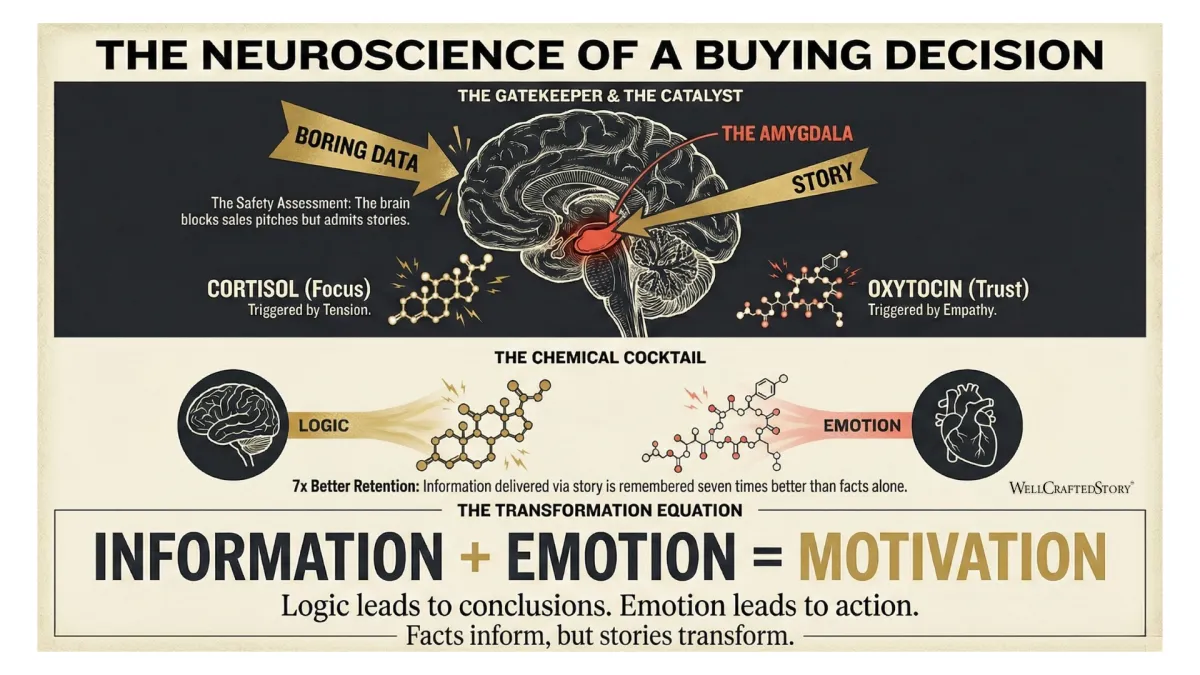
According to the neuroscience cited in The WellCrafted Story, the brain follows a predictable sequence before it allows movement.
Safety assessment comes first
The limbic system decides whether a message is relevant or ignorable within seconds. If the audience does not recognize their problem in the opening moments, attention drops.
Emotion determines priority
Research shows that information paired with emotion is tagged as important by the hippocampus. Data without emotional relevance is processed as optional.
Story lowers resistance
Studies on narrative transportation demonstrate that when people are absorbed in a story, analytical defenses decrease. The brain stops arguing and starts imagining.
Future projection enables decisions
Before taking action, the brain simulates outcomes. If the future is not clear or does not feel safe, decisions are delayed or avoided.
When a speaker jumps straight to features, charts, and mechanics, the brain never completes this sequence.
What is the hidden cost of messages that stall at understanding?
When communication informs but does not move, the cost is rarely obvious in the moment.
It shows up later as:
Longer sales cycles
Repeated explanations
Missed follow-ups
Unclear alignment
Lost revenue that is blamed on timing or market conditions
In reality, the opportunity was lost earlier, when the message failed to guide the brain from clarity to action.
How does structure change the outcome?
The difference between interest and action is not persuasion. It is architecture.
Effective messages:
Define the problem before presenting the solution
Use story to create emotional relevance
Organize information into clear patterns the brain can follow
Help the audience imagine a safe, desirable future state
This is why structure is not a stylistic choice. It is a neurological requirement.
When structure aligns with how people think, action becomes the natural next step.
What should leaders take away from this?
Every high-stakes message carries an invisible price tag.
If it does not move people, it costs time.
If it does not create clarity, it costs trust.
If it does not lead to decisions, it costs revenue.
The goal is not to say more.
It is to say what the brain needs, in the order it needs it.
That is how messages stop stalling and start moving people to action


