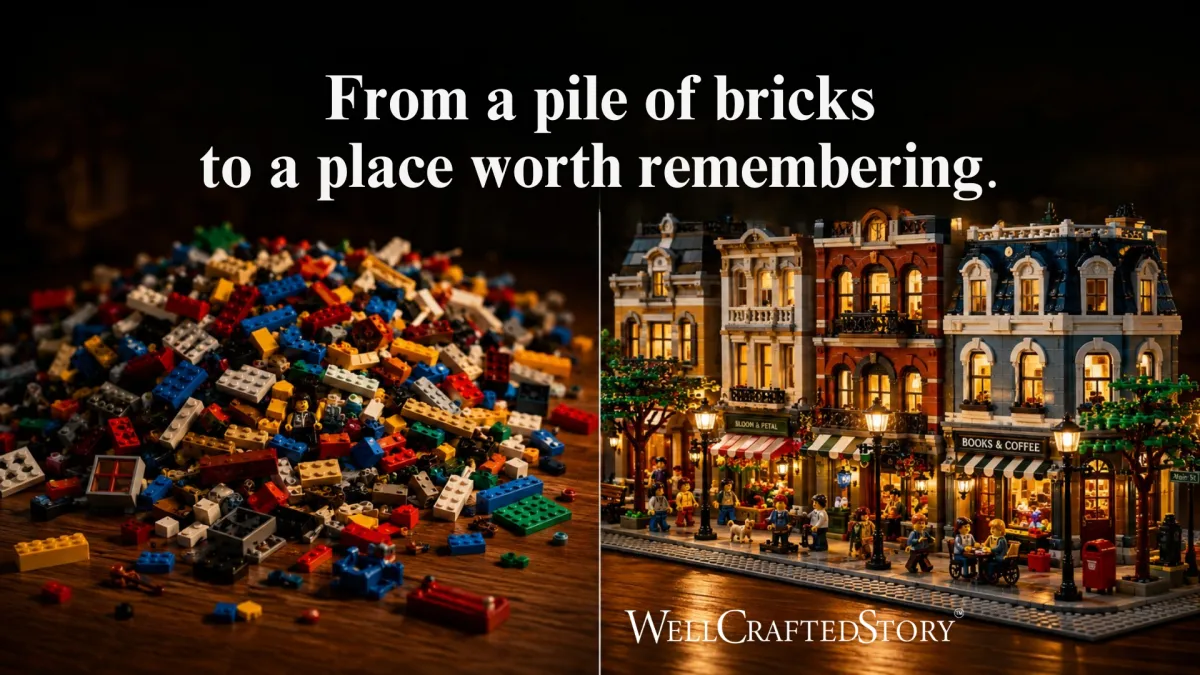
From a Pile of Bricks to a Place Worth Remembering
From a Pile of Bricks to a Place Worth Remembering
SUMMARY
4 Minute Read. This article explains why analytical leaders who excel at data, information, insight, and presentation still lose decisions to people with weaker credentials and less preparation. It shows how Dave Ward, Jimmy Hays Nelson, and Dr. Danny Brassell of WellCrafted Story identify vulnerability as the real barrier between a polished presentation and a message that moves people to act. The result is a clearer path to stage five communication for founders, financial advisors, and executives in high-stakes rooms.
By: Dave Ward
When I was a kid, I loved LEGO.
But I always built what was on the box.
I would open the set, lay out every piece, find the instruction booklet, and follow each step until the picture on the cover was sitting in front of me. Diligent. Methodical. Complete.
My son was different.
He would build what was on the box too. But it was never long before he would take it apart and combine it with something else. LEGO Star Wars mixed with LEGO City. Spaceships parked on medieval castle walls. Stormtroopers in the corner shop. He did not see the sets as finished products. He saw them as raw material for something nobody had built yet.
I watched him do this for years and told myself a story.
He is the creative one. I am not. I'm a rule follower. He's free.
That story followed me for a long time, even though I never thought about it until yesterday. I stayed in the lane I was good at. Law. Analysis. Process. Things with instructions. Things with rules. Things with a right answer. I did not try to build things that did not have a picture on the box because I had already decided I was not the kind of person who could.
I took an art class as an elective at San Diego State University just to graduate and it was one of the most difficult classes of them all. Because, "I'm not an artist."
Then, after the 2008 financial crisis crushed my law practice, I started my first company and had no choice.
There was no box. No instructions. No picture to follow. I had to create or lose my house. So I tried things other people had not thought of, took risks I would never have taken inside a structure, and built something that did not exist before.
It turned out I was creative the whole time. I had just been telling myself otherwise. It turns out fear is a powerful tool for personal change.
The Story You Tell Yourself
I shared a version of this story in the comments of a LinkedIn post this week.
The Founder of Teal Canvas, a firm that helps match artists with patrons, Jay Gutnick had written about two art installations and the story they came together to tell. I commented that his world "felt foreign to mine". He pushed back. He pointed out that what he does, listening, guiding, helping someone put their story out into the world, was exactly what I do. We just work in different mediums, but we both create art.
I told him I had never thought of it that way.
He said: "that is a story you tell yourself. A self-imposed story. One that would be well served to shed."
I knew he was right. I've spent the last 20 years of my life focused on self-awareness and I've grown tremendously as a result. But, as I told Jay, that story is "some old baggage that I guess I haven't fully unpacked yet."
And that exchange is exactly what this newsletter is about.
The Five Stages
This week I posted a graphic on LinkedIn that I have been sitting on for a while.
It showed five stages of a progression using LEGO bricks.

Each stage builds on the last. Data is the raw pile, chaotic, unfiltered, everything at once. Information is sorted and organized. Insight is where patterns emerge and meaning takes shape. Presentation is polished, structured, impressive.
And Story is where it becomes human. Memorable. Worth caring about.
The graphic resonated because most analytical professionals recognized themselves immediately. They are exceptional at stages one through four. Their training rewards it. Their clients expect it. Their career is built on it.
But the decision does not get made at stage four.
It gets made at stage five where it all comes together as a story.
The Real Barrier
Here is what I have learned working with founders, advisors, and executives who are stuck between stage four and stage five.
The barrier is not skill. They know how to communicate. They are intelligent, credible, and well-prepared.
The comments on my post revealed the roadblock. The barrier is vulnerability.
Getting to stage five requires saying out loud why solving this problem matters to you personally. Not just what you know. Not just what the data shows. Why you care. What you saw that nobody else saw. What it cost you.
That feels foreign to analytical people because their entire career has rewarded them for leaving themselves out of it. The analysis does not need their feelings. The presentation does not need their story. The data speaks for itself. Those are the "rules".
Except in the room where the decision gets made. In that room, the data never speaks for itself. The person behind the data does. Whether you are a financial advisor looking to add clients or a Founder raising capital, YOU are a vital element of the decision.
We call this the gap between Presentation and Story. It is not a formatting problem. It is not a structure problem. It is a permission problem.
Most analytical professionals are not missing the ability to tell a story. They are missing the belief that their story belongs in a professional setting.
That is the self-imposed story Jay Gutnick was talking about.
The Moment It Shifts
I ended my exchange with Jay by saying something I did not plan to say.
I told him that I was writing this newsletter to unpack my bag and help others do the same, and said "I find writing to be the best way to think through things. Because, well, I'm creative like that."
I spent the first half of my life believing I was not creative and I genuinely thought that I had shed that belief. My words revealed the truth. It was lingering like a stain on your favorite sweater.
The person who spent decades believing he was not creative unpacked it in a LinkedIn comment thread. While writing a newsletter about LEGO bricks. About his son. About a limiting belief he had carried since childhood.
That is what happens when you give yourself permission to get to stage five.
You do not just tell a better story. You find out something true about yourself that the pile of bricks was hiding the whole time.
If you are ready to find what your story is hiding, the free Storytelling Blueprint at www.storywellcrafted.com is where that work starts. Jimmy Hays Nelson, Dr. Danny Brassell, and I built it for exactly this moment, when you know the data, you have the insight, you have the presentation, and you are standing at the edge of stage five wondering if you have permission to step in.
You do.
Dave Ward, JIMMY HAYS NELSON and Dr. Danny Brassell


