Why Clarity Wins Under Pressure
Why Clarity Wins Under Pressure
What the Super Bowl and a SaaS Pitch Reveal About High-Stakes Communication
Summary
This article explains why intelligent professionals default to complexity under pressure and how that instinct damages decision-making. It shows how the brain responds to cognitive overload, why structure reduces perceived risk, and how clear sequencing outperforms data-heavy presentations in high-stakes environments.
What Did the Super Bowl Reveal About Decision-Making Under Pressure?
In Super Bowl LX, the Seattle Seahawks defeated the New England Patriots 29–13.
Seattle did not win through offensive complexity. They won through disciplined defense and controlled execution.
When the pressure increased, Seattle simplified.
When the pressure increased, New England accelerated.
The result was decisive.
This same pattern appears in high-stakes communication.
Under pressure, most professionals increase complexity. The brain, however, becomes more sensitive to overload.
Pressure amplifies instinct.
And instinct is rarely structure.
Why Do Smart People Add More When Stakes Rise?
At an investor conference in Dallas, a young SaaS founder presented to a room of registered investment advisors and family offices.
He was intelligent.
He knew his product deeply.
He had strong data.
Under pressure, he added more detail.
More architecture diagrams.
More edge cases.
More technical explanations.
Investors were polite.
They did not move.
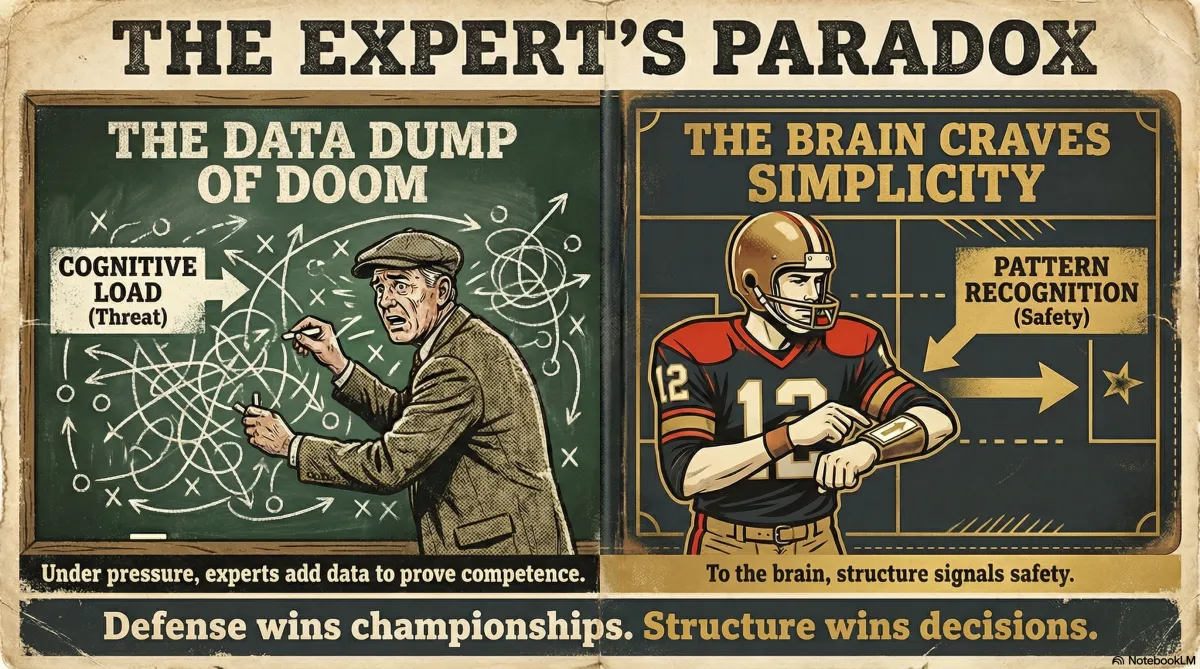
This pattern is described in our book The WellCrafted Story as the Data Dump of Doom.
When professionals feel evaluated, they attempt to validate expertise through volume.
They design for accuracy instead of absorption.
The problem is neurological, not intellectual.
How Does the Brain Respond to Complexity Under Stress?
The brain prioritizes safety before logic.
When cognitive load increases, the amygdala becomes more active. Increased complexity signals unpredictability. Unpredictability signals potential threat.
When perceived risk rises:
Attention narrows
Risk sensitivity increases
Decision-making slows
This is not emotional weakness. It is biological efficiency.
In contrast, structured information creates pattern recognition.
Pattern recognition reduces uncertainty.
Reduced uncertainty lowers perceived risk.
Lower perceived risk increases the likelihood of forward movement.
Structure signals safety.
Why Is Information Alone Not Enough?
Neuroscientific research supports this sequence.
Research by Uri Hasson demonstrates neural coupling, where story-based communication synchronizes brain activity between speaker and listener.
Research by Dr. Paul Zak shows that emotionally engaging narratives trigger oxytocin, increasing trust and cooperation.
Antonio Damasio’s work reveals that individuals with impaired emotional processing struggle to make decisions, even when logic remains intact.
These findings support a core WellCrafted principle:
Information + Emotion = Motivation
Logic produces conclusions.
Emotion enables decisions.
When presentations rely solely on data, they activate analytical processing but fail to activate trust, safety, or future projection.
As a result, audiences become impressed but inactive.
What Should the Founder Have Done Instead?
The SaaS founder was solving two distinct problems.
First, a market problem.
Companies were losing productivity due to disconnected workflows and inefficient systems.
Second, an investor problem.
Capital needed scalable, defensible growth opportunities with predictable revenue expansion.
Instead of beginning with technical architecture, he could have:
Named the operational pain businesses feel daily.
Illustrated the financial cost of inaction.
Described a transformation narrative.
Introduced the product as the logical bridge between current and future state.
This sequencing would have aligned with the 5 C’s Framework:
Clarity before complexity
Connection before content
Structure before detail
Complexity becomes persuasive only after safety is established.
Why Does Structure Win When Pressure Increases?
Under pressure, humans do not crave more information.
They crave predictability.
Defense wins championships because it prevents chaos.
Structure wins decisions because it prevents cognitive overload.
When messages lack structure:
Sales cycles lengthen
Meetings repeat
Capital hesitates
Momentum declines
When messages are structured clearly:
Risk perception decreases
Future projection increases
Decisions accelerate
Intelligence is not the variable.
Architecture is.
What Is the Real Lesson?
High-stakes communication is not a test of knowledge.
It is a test of sequencing.
The Patriots accelerated under pressure.
The SaaS founder expanded under pressure.
Both defaulted to instinct.
Structure requires discipline.
And discipline wins.


