Why Audiences Turn on You or Root for You Under Pressure
Why Audiences Turn on You or Root for You Under Pressure
Summary:
This article explains why audiences either disengage or support a speaker when something goes wrong. It shows how early connection shapes audience response under pressure. The result is stronger trust, resilience, and message delivery in high-stakes presentations.
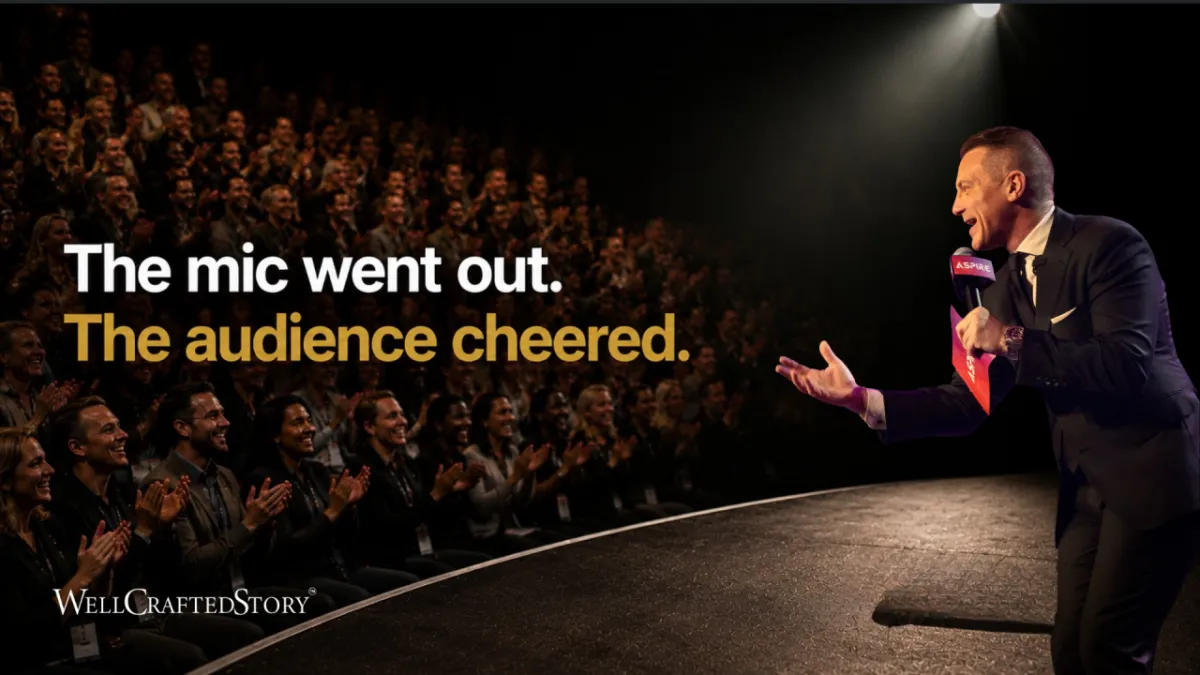
The mic went out. The audience cheered.
Three mics failed. He dropped the third one, raised his voice, and hit the back of the room.
When Jimmy Hays Nelson stepped off stage, the woman who runs events for Tony Robbins gave him a bear hug.
"Jimmy, I will put you on any stage, anywhere, anytime."
He asked her why.
"You know how many people I have watched melt down in that situation?"
Here is what most people miss about that story.
The audience did not just tolerate three mic failures. They cheered him on. By the third mic, they were rooting for him.
That did not happen because he was composed. It did not happen because he had a backup plan.
It happened because of what he did in the first sixty seconds before any of this started.
He connected.
Before he taught anything. Before he gave them the call to action. He spent the first sixty seconds making the room feel something about him as a human being.
And when the first mic went out, the audience was already on his side.
What nobody teaches about this.
Whether the audience roots for you or writes you off in that moment has almost nothing to do with how you handle the failure.
It has everything to do with what happened before it.
When a speaker connects with the room before the technology fails, the audience experiences the failure alongside them. They want it resolved. They are pulling for the speaker because they have already decided they like this person and want them to succeed.
When a speaker skips connection and goes straight to content, the failure lands differently. It reads as incompetence. The audience has no emotional investment in the outcome. The mic going out just confirms the distance they already felt.
Two speakers. Same technical failure. Completely different audience response.
The difference is not composure. The difference is connection.
The hidden dependency.
Most professionals build their confidence into their technology.
The slides become the structure. The notes become the safety net. The teleprompter becomes the voice. And when any of those things fail, the confidence goes with them.
It creates a dangerous dependency. When the technology works, the presenter looks polished. When it fails, the presenter has nothing to fall back on because the structure was never inside them to begin with.
The presenter who has internalized the structure is inconvenienced when the technology fails. Nothing more.
What internalized structure looks like.
The WellCrafted Story Five Cs are not a presentation template. They are a foundation you carry into every room regardless of what the slides are doing.
Clarity gives you the problem in your audience's language.
Connection gives you the human story that gets the room on your side before you teach anything.
Content limits you to three points so that when time gets cut, you know exactly what stays.
Call to Action gives you the one clear next step that cuts through chaos.
Close gives you the emotional landing that the audience takes with them when they leave.
When those five elements are internalized, the slides become optional. The teleprompter becomes a convenience. The notes become a backup rather than a lifeline.
Three moments where this saves you.
The slides freeze mid-presentation. The presenter who depends on the deck scrambles and loses the room. The presenter with internalized structure acknowledges it with a single sentence and keeps going. The audience barely notices.
The mic cuts out in a large room. The presenter who relies on amplification stops. The presenter who connected with the room before it happened raises their voice and continues. The audience leans in.
The time gets cut in half at the last minute. The presenter who built their confidence into a forty-five slide deck has no idea what to cut. The presenter who knows their Five Cs drops straight to the most essential version of each one and closes on time.
In every scenario, the technology failed. The structure did not.
The audience never knows what was supposed to happen. They only know what did.
Jimmy raised his voice and hit the back of the room. The audience was already rooting for him before the first mic went out.
That is the only kind of confidence that actually works when it matters most.
Not confidence that everything will go right. Confidence that the connection you built is strong enough to carry you through when it does not.
If this resonates and you want to build a message that holds under pressure, start a conversation with us here:
https://wellcraftedstoryworkshop.com/contact-us


