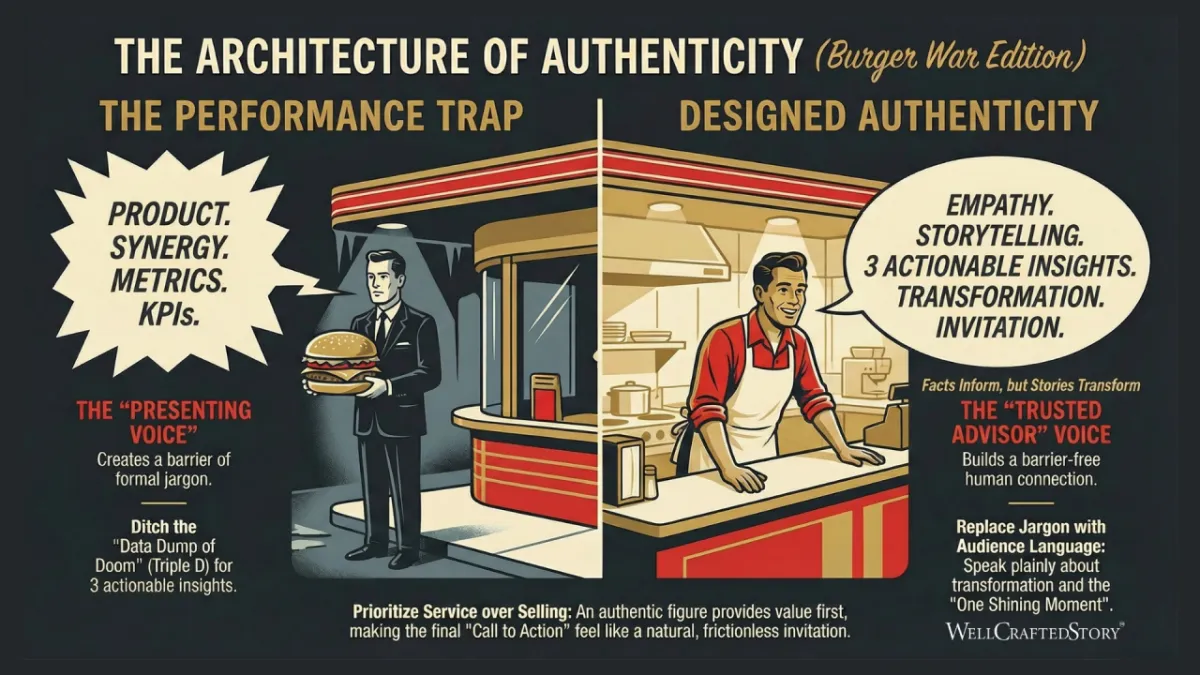
The Architecture of Authenticity
The Architecture of Authenticity
Summary:
This article explains why professionals fall into the Presenting Voice and lose trust in high-stakes communication. It shows how structure creates authentic connection without performance. The result is clearer messaging, stronger trust, and better outcomes.
The Architecture of Authenticity
Most communication advice tells you to be more authentic.
That is not advice.
That is a destination without a map.
A few weeks ago, a fast food executive gave us a clear example of what happens when a smart, prepared professional walks into a room and performs instead of connects.
And his competitors showed us, without saying a word about it, exactly how to fix it.
The Performance Trap
When the McDonald’s CEO described his burger as a product eleven times in sixty seconds, the internet laughed.
We paid attention to something else.
His language revealed his focus.
He was thinking about the product.
Not the person.
And the audience felt that gap immediately.
This is what we call the Presenting Voice.
It shows up when the stakes are high.
Formal.
Stiff.
Technically complete.
It speaks in metrics, synergies, and solutions.
It reaches for industry language when the person in front of you lives in a completely different world.
The Presenting Voice does not lie.
It just creates distance.
And when that distance shows up, the room leans out.
This is not a fast food problem.
It is the advisor describing a plan as a financial vehicle.
The founder calling their company a SaaS solution.
The consultant opening with a framework instead of a problem.
All of them performing authority instead of building trust.
The Trusted Advisor Voice
Within 48 hours, competitors responded.
No rebuttals.
No scripts.
No attempt to sound more authentic.
They changed the environment.
Burger King’s president walked into a kitchen and ate the product.
Wendy’s president cooked the meal.
A&W used humor and context to make the original language feel absurd.
They moved from the Presenting Voice to the Trusted Advisor Voice.
Empathy before argument.
Story before credentials.
Transformation before transaction.
The difference is not personality.
It is structure.
They removed the conditions that made performance necessary.
By the time they spoke, there was nothing left to perform.
The Design Decision
You do not become more authentic by trying harder.
You become more authentic by removing the need to perform.
When you start with your audience’s problem, you stop performing.
When you open with a story, you stop presenting and start connecting.
When you use your audience’s language, you stop translating and start being understood.
When your call to action feels natural, the room moves toward you.
This is what the WellCrafted Story framework does.
It is not a style.
It is an architecture.
Clarity aligns your message with your audience’s reality.
Connection builds trust before you present information.
Content delivers your ideas in a structure the audience can follow.
Call to Action creates a clear next step.
Close gives the audience something to carry forward.
When that structure is in place, authenticity is not something you find.
It is what remains.
Good ideas fail without structure.
The product was not the issue.
Structure was.
If this resonates and you want to communicate clearly without the performance, start a conversation with us here:


