The Premature Fade-Out: Why Your Presentation Needs a Real Ending
The Premature Fade-Out: Why Your Presentation Needs a Real Ending
This article explains why many presentations fail to create action even when the content is strong. It shows how unfinished message structure causes audiences to disengage, why rushed endings prevent decisions, and how intentional structure ensures a presentation resolves clearly so people understand what to do next.
Why do unfinished stories bother us?
My wife and I watch movies together most nights.
She often falls asleep halfway through. I almost never do.
Even if the movie is bad. Even if I dislike the plot. Even if I know how it will end.
I finish it anyway.
The reason is simple. The human brain craves closure. Unfinished stories create tension. Finished stories create relief.
Your audience responds to presentations the same way.
What is the “Premature Fade-Out” in presentations?
Most presentations do not end cleanly. They fade out.
The speaker runs long.
They drift away from the original point.
They notice the time and rush the ending.
The Call to Action becomes compressed, softened, or skipped.
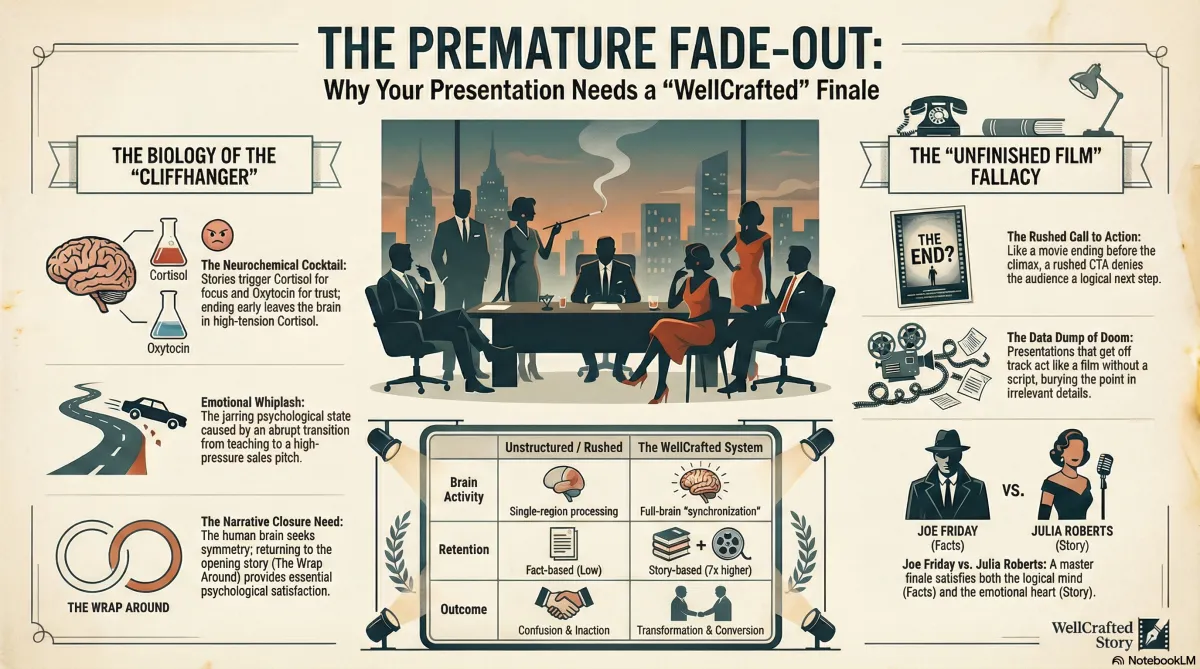
This is what WellCrafted Story refers to as the Premature Fade-Out. The message never resolves. The audience never receives a clear conclusion.
As a result, the presentation feels incomplete.
Why does a rushed ending stop action?
When a presentation builds tension but fails to resolve it, the brain remains unsettled.
Stories increase focus by raising cortisol, which sharpens attention. A proper ending releases oxytocin, which creates trust and resolution.
When the ending is rushed or missing, the brain stays in tension without relief. Without resolution, the audience cannot clearly evaluate what happens next.
When the brain cannot picture the next step, it defaults to inaction.
This is why audiences applaud but do not move.
Why do speakers keep running out of time?
Running long is rarely a time management problem.
It is a structure problem.
When a message is not architected in advance, content expands without boundaries. As pressure increases, the ending becomes expendable.
The Call to Action feels awkward because it was never integrated into the structure of the story. It appears suddenly instead of arriving naturally.
Unstructured messages sacrifice the ending first.
How does structure prevent the Premature Fade-Out?
Structure protects the ending.
In a WellCrafted presentation, the close is not an add-on. It is designed from the beginning.
Structure ensures that:
The message follows a clear sequence
The content supports a central idea
The ending resolves the tension introduced at the start
The audience understands one clear next step
When structure is intentional, the ending receives the time and attention it requires.
What does a complete ending provide?
A complete ending does three things for the audience:
It returns to the original problem.
It resolves the tension the brain has been carrying.
It creates clarity about what happens next.
This is not pressure. It is closure.
When a message finishes cleanly, the audience feels safe enough to decide.
What should presenters take away?
Great messages do not need to be longer.
They need to be finished.
If a presentation ends abruptly, the audience does not reject the idea. They hesitate because the story never resolved.
Structure is what turns a message into a complete experience.
And completion is what allows action to happen.


