Why CTAs Fail and How to Fix Them: The Natural Bridge
Why CTAs Fail and How to Fix Them With the Natural Bridge
This article explains why calls to action often fail even after strong presentations. It shows how abrupt shifts into selling trigger resistance, why this happens neurologically, and how the Natural Bridge technique keeps offers aligned with the audience’s needs so action feels like a logical next step rather than a pitch.
Why do strong presentations still fail at the call to action?
Rachel is one of the brightest nutritionists I have ever met.
She taught cutting-edge research on gut health. Her audiences loved her energy. They took notes. They nodded along. They asked thoughtful questions.
But almost no one signed up to work with her.
Every presentation followed the same pattern. She would teach confidently, then reach the call to action and become someone else entirely.
Her voice softened. She apologized. She said things like:
“So that is all I have. I guess if anyone is interested, I do have some programs available. Sorry to mention it.”
The content was strong. The offer was solid.
The failure happened in the transition.
What actually causes audiences to resist a call to action?
The moment Rachel shifted from teacher to salesperson, the audience felt it.
That shift triggered what psychologists call persuasion resistance. The talk had been helpful, then suddenly felt uncomfortable. The audience pulled back.
Nothing about her program caused the resistance.
The problem was architectural, not personal.
When a speaker changes tone, energy, or intent at the close, the audience’s brain detects inconsistency. Trust weakens. Momentum stalls. Action feels risky.
A call to action fails when it disconnects from the story that came before it.
What is the Natural Bridge and how does it fix this problem?
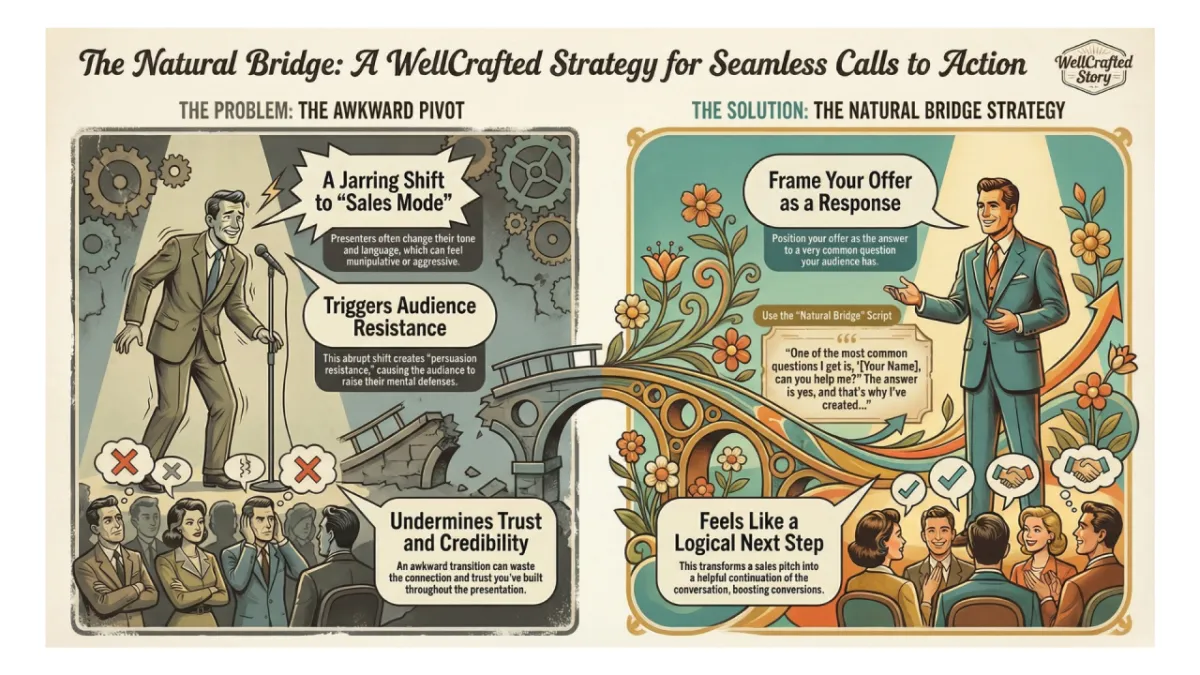
The Natural Bridge is a structural transition that keeps the speaker’s role consistent from start to finish.
Instead of presenting the offer as something the speaker wants to sell, it frames the offer as the answer to a question the audience is already asking.
Together, Dr. Danny Brassell and Jimmy Hays Nelson helped Rachel rebuild her close using this approach.
In her next presentation, she used a different transition.
She said:
“The question I hear most often is, ‘Rachel, this is fascinating, but how do I actually implement these changes in my busy life?’ That is exactly why I created my 90-Day Gut Reset Program.”
The teaching did not stop.
The help simply continued.
Why does the Natural Bridge work so well?
A call to action only feels sales-driven when it breaks the narrative.
People trust guides who remain consistent. They distrust guides who suddenly change roles.
The Natural Bridge works because it maintains alignment. It positions the offer as a logical continuation of the value already delivered.
The audience does not feel sold to. They feel responded to.
Rachel signed up fourteen new clients that day. More than she had enrolled in the previous six months combined.
How can you create your own Natural Bridge?
Here is the simplest version of the Natural Bridge script:
“One of the most common questions I get is, ‘[Your first name], can you help me [solve a specific problem]?’
The answer is yes, and that is why I created [your offer].”
This structure removes pressure from the speaker and confusion from the audience.
A strong call to action is not a pitch.
It is an invitation to keep going.


