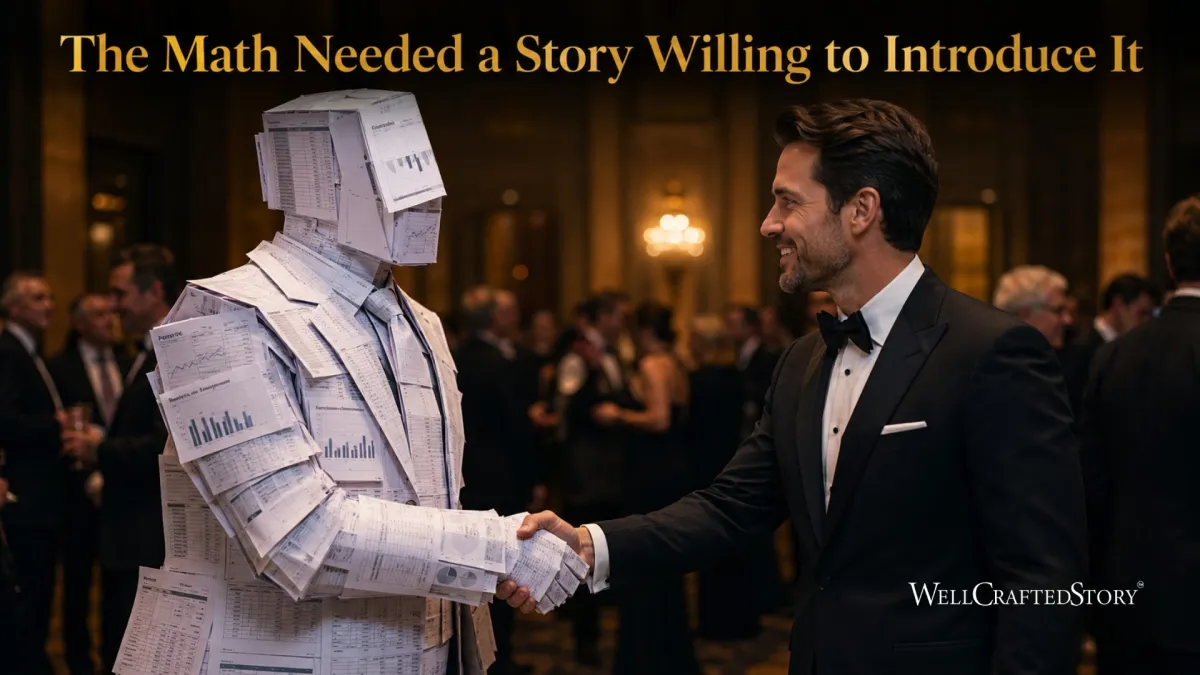
The Math Needed a Story Willing to Introduce It
SUMMARY
This article explains why numbers alone rarely convince a family office, RIA, or prospect to move forward, even when the numbers are strong. It shows how trust changes the way those numbers get reviewed, and offers a plain-language method for finding the specific story worth telling, along with a repeatable "know, like, trust" framework for building credibility from scratch. The result is a clearer approach to earning a second conversation in high-stakes investor and prospect meetings, drawn from the coaching work of Dave Ward, Jimmy Hays Nelson, and Dr. Danny Brassell.
The Math Needed a Story Willing to Introduce It
Last week I had lunch with a founder raising capital from family offices and RIAs. Sharp guy, plenty of experience, not easily impressed by a pitch, but with a strong desire to make sure his left an impact.
As we were leaving, he told me he was glad we met because we solve a problem he didn't know he had. He'd spent years convinced that strong numbers alone would move family offices and RIAs to invest. Real traction, real growth, a track record built to survive scrutiny.
After talking with us, he saw it differently. The numbers were never the whole battle. The real goal of a first conversation was never to close the deal, it was to earn a second one.
I wrote about that lunch this week on LinkedIn. What happened in the comments went further than the post itself did.
Trust Doesn't Just Get You the Meeting. It Changes How the Numbers Get Read.
A few different people asked variations of the same question: does building trust actually change anything, or does it just buy you a friendlier audience for the same spreadsheet?
My answer, given three separate times to three different people, ended up being the same each time. Trust doesn't soften the numbers. It softens the eyes reviewing them. Once someone trusts you, the review stops being an audit looking for a reason to say no, and starts being a conversation looking for a reason to say yes.
That's not a small distinction. Two people can look at the exact same spreadsheet and reach opposite conclusions, depending on whether they walked in already skeptical or already rooting for you.
Where Trust Actually Starts: Like, Know, then Trust
We've all heard the saying "People do business with people they know, like and trust." But, that isn't really the correct order. If you're building credibility from zero, you can't start with trust directly. It's the third step, not the first.
The order matters. Like, then know, then trust. Most people try to skip straight to trust by leading with credentials, degrees, and accomplishments. But credentials only prove competence. You can't get to know a resume, and you can't like a list of accomplishments. If you're starting from nothing, the easiest one of the three to move first is like. Once someone likes you, they're willing to get to know you. Once they know and like you, trust has somewhere to grow.
If you are presenting to a room, being likeable starts with being memorable and nothing makes you more memorable than a tactical stories that help people understand who you are, why you do what you do and how you can solve their problem(s).
Finding the Story That Actually Works
Knowing you need a story is one thing. Finding the right one is another.
Most founders default to the story they're proudest of, the milestone, the big win, the achievement that looks best on a slide. That's usually the wrong one.
The story that earns a second conversation isn't the achievement. It's the moment right before it, the specific point where something clicked and you saw the problem differently than you had before.
Here's why that works. People rarely change their mind because you handed them a fact. They change their mind when you walk them through the same moment of realization you had, so they arrive at the belief themselves instead of being told to believe it.
So the question isn't "what am I most proud of." It's more along the lines of "what did I believe was true, right up until the moment I didn't anymore, and what changed my mind." Tell that moment honestly, and something happens that a list of accomplishments never manages. The other person gets to have your realization too, standing exactly where you're standing now.
The Numbers Still Matter. They Just Need to Be Custom.
None of this means the numbers don't matter, or that a good story lets you skip the data. It means the transition from story to numbers has to be handled carefully, or you lose the connection you just built.
The numbers need to speak to the specific concerns of the people in the room. A generic pitch deck doesn't do that. This is especially true with family offices, since each one carries a distinct identity and philosophy. Taking the time to build a custom deck that addresses their specific priorities is what keeps the emotional connection intact once the conversation shifts to data.
What Danielle Patterson Added
Danielle Patterson, who works closely with founders and family offices, put it plainly in the comments: the first conversation is rarely about closing a deal, it's about earning the trust to have a second conversation. Education, thoughtful outreach, and leading with value consistently outperform a pitch deck. The numbers matter, but they're usually what validates the opportunity after trust has already started to form.
The Line That Stuck
One comment, from Reeshav Bamrolia, put the whole argument in a single sentence: the math needed a story willing to introduce it.
That's the whole idea. Numbers get you credibility. Story gets you the second meeting. Neither one does the other's job.
If you've been leading with your numbers and wondering why the room goes quiet, a free story audit with Jimmy is the first step. Book it at www.wellcraftedcall.com.
Dave Ward, Jimmy Hays Nelson, Dr. Danny Brassell


