How Much Should You Give Away in One Talk?
3 Minute Read
This article explains why giving away your best material only builds trust when the audience can act on it. It shows how WellCrafted Story, founded by Dave Ward, Jimmy Hays Nelson, and Dr. Danny Brassell, uses three tests to decide what belongs in a talk: where the audience is, how much time there is, and how deep the topic needs to go. The result is a talk people can act on in client presentations, investor pitches, and conference sessions.
How Much Should You Give Away in One Talk?
The speaker had 45 minutes. He had about 90 minutes of material.
I watched him try to fit one inside the other at a recent conference.
He never landed the plane.
The content was good. There was simply too much of it for the room and the clock, and a talk that tries to say everything usually lands nothing.
At the same event, other speakers did the opposite. They showed us, step by step, exactly how to build something, and I left wanting to follow them. In a recent post, I wrote about why giving away your best stuff is how you earn trust.
That raises a fair question. How much do you give away in one talk? Give away too much and nobody can use any of it. People who leave with 30 ideas act on none of them.
Here are the three tests we use when we build presentations with clients.
Test 1: Where Is Your Audience?
This one comes first, and it isn’t negotiable. Clarity starts with who you’re talking to.
The room at this conference was mostly experienced users of the software, so speakers could go deep without losing anyone. The same content in front of beginners would have buried them.
The reverse happens too. At a convention in Indianapolis in 2018, a keynote speaker opened by saying she was there to talk to the women in the room. About 30% of the audience, the men, had just been told it wasn’t for them. Phones came out. I got up and got coffee. Good content, aimed at only part of the room.
Test 2: How Much Time Do You Really Have?
The speaker with 45 minutes and 90 minutes of material planned for the content instead of the clock.
In the 5 C’s, Content means three points maximum. Not because three is magic, but because it’s what a room can carry out the door. If you have more than three good ideas, you have more than one talk.
Start with the time you have, then decide what earns a place in it.
Test 3: How Deep Does It Really Need to Go?
Ask how complicated the thing really is, and how far into the weeds someone has to go to understand it.
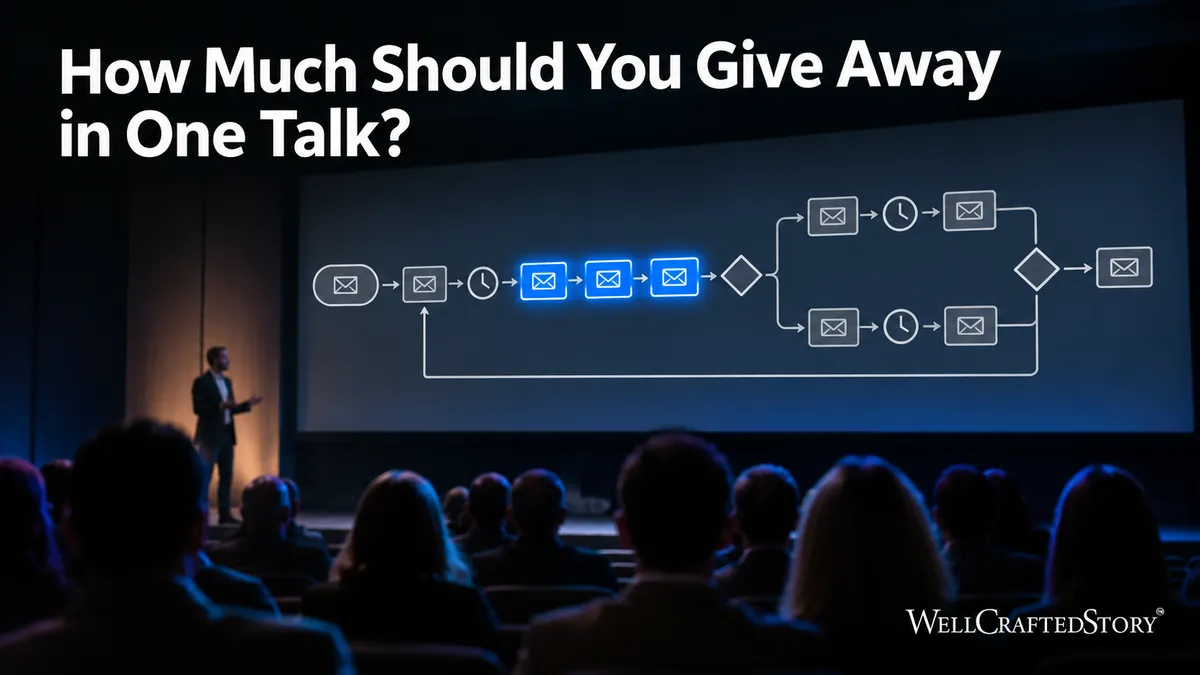
The smartest speakers used flowcharts to show the architecture of a solution, not every nut and bolt. They showed the whole map so the audience could see it was real, then spent their time where the detail added value.
If you have a 10-step process, explaining three steps in useful detail and showing the rest on the map is a good compromise. The audience gets something they can use, plus proof you know the rest.
Why This Builds Trust
When you show how you do what you do, it stops looking like magic. The people who can build it themselves trust you more. The people who can’t know exactly who to call.
Both outcomes start with the same thing: giving people enough to act on.
The Next Step
If you are deciding what to put in your next talk, the Storytelling Blueprint is the first step. It is free at www.storywellcrafted.com.
Your audience doesn’t need everything you know. They need the right part of it, and the confidence that you have the rest.
Dave Ward
Jimmy Hays Nelson
Dr. Danny Brassell
Dave Ward, Jimmy Hays Nelson, and Dr. Danny Brassell are the founders of WellCrafted Story, a communication advisory firm that helps leaders communicate with clarity and precision in high-stakes situations.


