Managing Hostile Audiences | WellCrafted Story
Managing Hostile Audiences: How to Maintain Control When the Room Turns
Summary:
Hostile audiences follow predictable patterns. When you understand them, you can maintain control, reset attention, and guide the room back to clarity and action.
Managing Hostile Audiences: How to Maintain Control When the Room Turns
Every speaker knows the moment.
You feel it before anyone says a word.
Arms cross. Eyes drop. Phones appear. Someone leans back in their chair like a judge.
The room has not exploded. But the energy has shifted.
What most speakers do not realize is that hostile audiences are rarely random.
They follow patterns.
And if you recognize the pattern, you can control the room.
Why Hostile Behavior Appears
High stakes communication creates pressure.
When people feel uncertain, skeptical, or disengaged, they try to regain control.
They do it through behavior.
Interrupting. Dominating. Withdrawing. Challenging.
These reactions are not really about you.
They are about status, certainty, and attention inside the room.
Most presenters handle this emotionally.
They argue with challengers.
They try to outtalk dominant personalities.
They ignore skeptics.
They pretend distractors are not there.
That is when authority breaks down.
Authority does not come from winning arguments.
It comes from maintaining structure under pressure.
Pattern Interrupts Reset Attention
When a presentation begins, the audience quickly predicts what will happen.
Slides. Talking. More slides. More talking.
Once the pattern is predictable, attention drops.
The brain shifts into energy saving mode.
Strong speakers break that pattern.
They reset attention.
You can do this with:
Proximity by moving closer to the audience
Vocal contrast by lowering your voice
Strategic pauses that force attention
Stage movement to signal a shift
Props that create curiosity
Humor that breaks expectation
One shift is often enough.
The moment the pattern changes, attention returns.
Once attention is back, you can manage the room.
The Four Audience Types
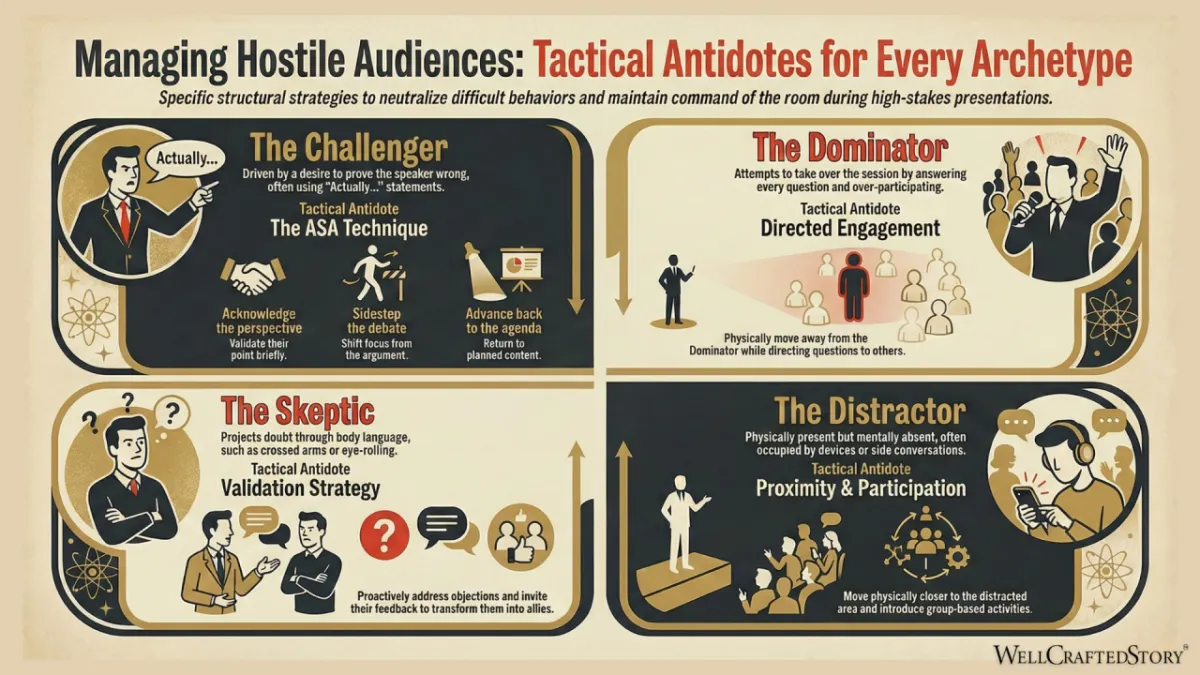
Most difficult rooms fall into four patterns.
The Challenger
They try to prove you wrong.
Response: Acknowledge briefly. Validate. Move on.
Do not debate. Return to structure.
The Dominator
They try to take over the room.
Response: Redirect attention. Call on others. Control participation.
The Skeptic
They show doubt through body language.
Response: Engage them. Ask for input. Turn resistance into participation.
The Distractor
They are present but disengaged.
Response: Move closer. Increase interaction. Bring them back in.
Structure Is the Real Authority
Authority is not confidence.
It is structure.
When the room shifts, structure keeps you grounded.
Clarity keeps you focused on their problem.
Connection keeps the room engaged.
Content keeps the message simple.
Call to action gives direction.
Close creates meaning.
When this is internalized, you do not react to the room.
You guide it.
The Real Shift
Hostile audiences are not something to fear.
They are something to understand.
Once you see the pattern, you stop reacting.
You start leading.
That is the difference.
If you want to build the structure that holds when the room shifts, start here:


